Creatine and Hydration: The Two Simplest Upgrades to Your Training
Creatine is the most researched supplement in sport. Water is the most overlooked. Here is what they do, how to use them, and why they work best together.
By Clay Livingston · · 8 min read
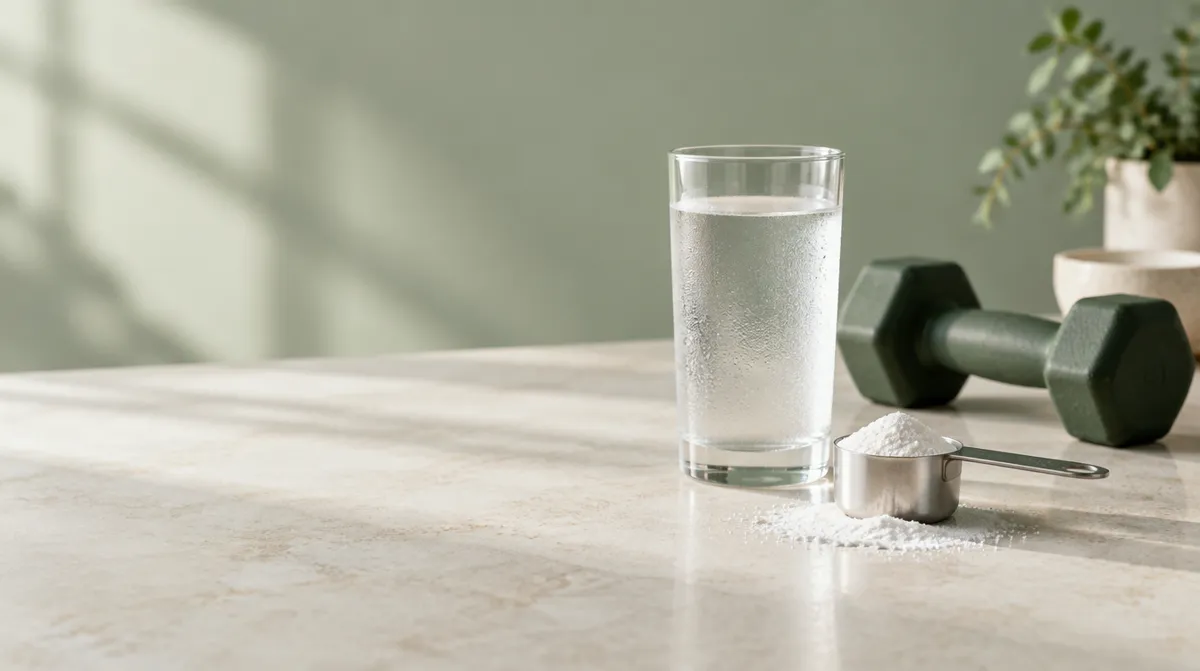
If I could only give someone two changes to make to their training, neither of them would be a new workout.
They would be a daily scoop of creatine and a proper plan for water.
Both are cheap.
Both are simple.
And both are backed by decades of research.
This guide covers what creatine does, how to take it, the myths that put people off, and how much water you need when you train.
What is creatine?
Creatine is a compound your body already makes from amino acids.
You also get it from food, mainly red meat and fish.
Around 95% of it is stored in your muscles.
There, it helps your body quickly regenerate ATP, the fuel your muscles use for short, hard efforts.
Think of the last few reps of a set, a sprint, or a 45 second round of burpees.
That is where creatine does its work.
Diet alone usually leaves your muscle stores around 60 to 80% full.
Supplementing tops them up to 100%.
Those extra few percent are where the benefits come from.
The benefits for training
The International Society of Sports Nutrition calls creatine monohydrate the most effective nutritional supplement currently available for increasing high-intensity exercise capacity and lean body mass.
In practical terms, this is what the research shows:
More reps and more power.
You can get an extra rep or two per set, and repeat hard efforts with better quality.
Over months, that extra work adds up to more strength and more muscle.
Better results from interval training.
Circuits, supersets and HIIT all rely on short, repeated bursts.
Creatine helps you hold your output from round one to round three.
More lean muscle.
Combined with resistance training, creatine consistently leads to greater gains in lean mass than training alone.
Faster recovery between sessions.
Studies show less muscle damage and better recovery after hard training.
Useful as you get older.
For adults over 50, creatine combined with strength training helps preserve muscle and strength.
This becomes more important with every year.
A bigger effect if you eat little or no meat.
Vegetarians and vegans start with lower stores, so they tend to see a larger response.
There is also early research on creatine and brain function, particularly during sleep deprivation.
It is promising, but it is not the reason to take it today.
How to take creatine
Keep this simple.
Type: Creatine monohydrate.
It is the most studied form and the cheapest.
Other forms such as creatine HCl or buffered creatine have not been shown to work any better.
Daily dose: 3 to 5 grams per day, every day.
That is roughly one level teaspoon.
Loading (optional): If you want faster results, take about 20 grams per day for 5 to 7 days.
Split it into 4 doses of 5 grams.
Then drop to 3 to 5 grams per day.
Without loading: 3 to 5 grams per day will fully saturate your muscles in about 3 to 4 weeks.
You arrive at the same place, just a little later.
Timing: It matters far less than consistency.
Take it at the same time each day so it becomes a habit.
Many people add it to a post-workout shake or their morning drink.
Rest days: Keep taking it.
Creatine works by keeping your stores full, not by giving you a boost on the day.
Quality: Look for a product that is third-party tested.
In the UK, look for the Informed Choice or Informed Sport mark.
Informed Sport tests every batch, so it is the stricter of the two.
The myths
"Creatine makes you bloated and fat"
Creatine can add 1 to 2 kg on the scales in the first few weeks.
This is water being drawn into your muscle cells, not fat.
Well-hydrated muscle is a good thing.
If you track your weight while losing fat, expect this jump and keep going.
Your waist measurement and your photos will tell the real story.
"Creatine is bad for your kidneys"
In healthy people, studies lasting up to five years have not shown harm to kidney function at recommended doses.
One thing to know: creatine can raise creatinine on a blood test.
Creatinine is a marker doctors use to check kidney function.
If you are having blood work done, tell your GP you take creatine.
"Creatine causes hair loss"
This idea comes from a single 2009 study on rugby players.
It showed a rise in DHT, a hormone linked to hair loss.
It did not measure hair loss itself.
A 2025 randomised controlled trial looked specifically at this.
After 12 weeks of 5 grams per day, it found no significant changes in DHT or hair follicle health compared with placebo.
"Creatine dehydrates you and causes cramps"
This is the big one, and it leads straight into the second half of this guide.
The research does not support it.
A review of the evidence found that creatine does not cause cramping or dehydration.
If anything, it may help your body handle heat.
Creatine does pull more water into your muscles, though.
That is one more reason to have your hydration sorted.
Why hydration matters for training
Most people who train hard are not short of effort.
Many of them are short of water.
The American College of Sports Medicine recommends avoiding a loss of more than 2% of your body weight through sweat during exercise.
Beyond that point, performance drops.
For an 80 kg person, 2% is just 1.6 kg.
A hard session in a warm room can get you there in about an hour.
When you are even mildly dehydrated:
Workouts feel harder than they should.
Your heart rate runs higher at the same effort.
Your strength and endurance drop.
Your focus and coordination slip.
Recovery takes longer.
Hunger and thirst can also feel similar.
Staying hydrated makes it easier to stick to a nutrition plan.
How much water do you need?
The European Food Safety Authority sets an adequate total water intake of:
2.0 litres per day for women
2.5 litres per day for men
That includes water from food, which usually provides around 20% of it.
The NHS suggests 6 to 8 glasses of fluid a day as a starting point.
Water, milk, sugar-free drinks, tea and coffee all count.
Training adds to this.
So do heat, a big body, and heavy sweating.
The simplest daily check is the colour of your urine.
Pale straw is where you want to be.
Dark yellow means drink more.
A simple hydration plan for training days
Before you train:
Drink roughly 5 to 7 ml per kg of body weight about 4 hours before.
For an 80 kg person, that is about 400 to 550 ml.
Top up with a few mouthfuls in the last 30 minutes if you need to.
During your session:
Sip water between rounds or blocks.
For sessions under an hour, plain water is enough.
For sessions over an hour, or if you are sweating heavily, add electrolytes, particularly sodium.
After your session:
Weigh yourself before and after one of your normal workouts.
For every 1 kg you lose, drink around 1.5 litres over the next few hours.
The extra covers what you keep losing through urine.
A meal with some salt helps you hold on to it.
One caution:
More is not always better.
Drinking very large amounts of plain water during long events, without sodium, can be dangerous.
Aim to replace what you lose, not to flood your system.
Putting it together
Creatine helps your muscles produce more power in short, hard efforts.
Water keeps your whole system running while you do it.
Take 3 to 5 grams of creatine monohydrate every day.
Drink to pale urine every day.
Drink properly before, during and after every session.
That is it.
No complicated stack. No expensive powders.
Just two habits that make every session count.
Build a workout to put this to use
The FuelPlan workout builder lets you set up supersets and circuits with your own work and rest times, such as 45 seconds on, 30 seconds rest, 3 rounds per block.
Short, repeated efforts like these are where creatine shines.
Use the rest periods to sip water.
This article is for general information only and is not medical advice. Speak to your GP or a registered dietitian before starting creatine if you have kidney disease, diabetes, high blood pressure, take regular medication, are pregnant or breastfeeding, or are under 18.
Sources
- Kreider RB et al. (2017). ISSN position stand: safety and efficacy of creatine supplementation in exercise, sport, and medicine. JISSN.
- Dalbo VJ et al. (2008). Putting to rest the myth of creatine supplementation leading to muscle cramps and dehydration. BJSM.
- Does creatine cause hair loss? A 12-week randomized controlled trial (2025). JISSN.
- Sawka MN et al. (2007). ACSM position stand: Exercise and fluid replacement. MSSE.
- European Food Safety Authority. Dietary reference values for water.
- NHS. Water, drinks and hydration.